Your buyer searched the ingredient.
Be the shop that answers.
Skincare and haircare shoppers look up the active, the concern and the routine before they look up a brand. Today the magazines answer them. You stock the answer, and you can publish it straight into your store.
Written for shops where the person packing the orders is also the person who would write the blog.
One full article free. No card required, no time limit.

What actually works
The search is for niacinamide, not for you
A beauty shopper rarely types a brand into a search box first. They type the active, then the problem: niacinamide for large pores, retinol or retinaldehyde, how to layer vitamin C under sunscreen, a routine for oily skin, how often to wash curly hair. The pages that answer those searches today are magazines, and in skincare those magazines, which sell no skincare at all, are who a shopper meets first.
The magazine can tell a reader what niacinamide does. It cannot tell them what is in the bottle. You can: the concentration, what it pairs with, what it should never be layered over, which of your customers it suits and which it does not. An article that answers the search honestly and ends at your product is doing sales work. The one about how the range came to exist is doing something else, and it is worth knowing which of the two you are publishing.
Reaches a buyer
- What one ingredient does, for which concern, at what strength
- A morning and evening routine for one skin or hair type
- Two actives that look interchangeable and are not
- What to stop doing before buying anything else
Reaches nobody
- Our founder's philosophy of clean beauty
- Five skincare trends to watch this season
- The launch post for a serum nobody has searched for yet
- Anything written because the calendar said Tuesday
Which ingredients and concerns your buyers actually search is a question with a measurable answer, and cpywrk measures it before anything gets written. Some months that says the routine guide rather than the launch post. You answer these questions in the inbox all week anyway, one shopper at a time; this is the version that keeps answering after you have closed the laptop.
The article that does the work
One ingredient, one concern, one honest article
The format that wins in beauty is the ingredient explainer: what it does, who it suits, at what concentration, how to use it, what not to combine it with, and then the product that carries it. Written for the reader who has not chosen a shop yet, not for the one already in your basket.
The same ingredient gets searched four different ways, and one well-built article can answer all of them:
- The head term
- "niacinamide". The reader wants the plain definition first, and the search check makes sure it is there, near the top, in one sentence.
- The concern
- "niacinamide for large pores". This reader is closest to buying. The article names the concern in a heading and answers it under that heading.
- The mechanism
- "how does niacinamide work". The explanation, in plain words, with the evidence it rests on cited rather than implied.
- The strength
- "10% or 5%". The question a shopper asks an assistant, so the answer is written as a quotable paragraph, which is what the AI answers check grades.
Cosmetic claims have rules. In the EU a cosmetic cannot claim to treat or cure, and a claim has to be one you can support. That is a reason to approve the outline before writing starts: the claim you cannot make is easiest to remove while it is still a heading. cpywrk writes to the brief you approved. It does not know what your product file supports, and it should not be trusted to. You do.
Where it ends up
An article in a document has never sold anything
A shopper who has just read why azelaic acid suits their redness is ready to buy it. That readiness lasts one tab. It survives a link to the serum. It does not survive a blog on a different domain from the shop, with the product three clicks and a search box away. cpywrk puts the finished article on the store with the product already in it.

Shopify, direct
Connect the store once. After that it is one button: press Publish and the article is live on your store, formatted.

WordPress, direct
Same again if your shop runs on WooCommerce, or its blog runs on WordPress. Connected once, then the same single button sends it.

Webflow, direct
Running the shop or its blog on Webflow? Connect the site once and pick the collection the articles land in. After that, the same single button sends it.
Anything else, by webhook
On any other platform, the webhook hands the finished article to whatever you do run.
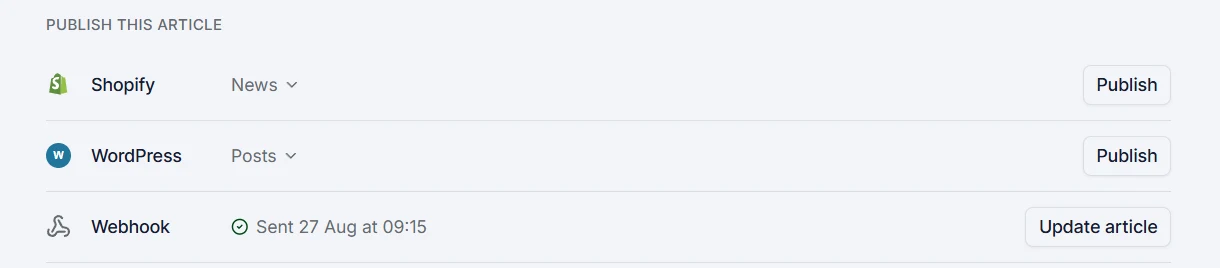
The article arrives with its product links in place and the images where they belong, so the shopper who just read why is one click from the thing itself.
Articles come out in English, Dutch or Czech, so a shop selling in Dutch publishes in Dutch.
The LinkedIn, X and Instagram versions come out of the same brief, written for how each one reads. Those are yours to post when you choose. We write them; we do not post them for you.
Before it publishes
Six checks, and they matter more when the article is doing sales work
An article that gets an ingredient wrong costs a beauty shop more than one sale. The reader was about to put it on their face, and a shop that was careless once is not trusted twice. That is a lot to rest on one loose sentence, and it is why the checks below run before a draft ever reaches you.
Search
It targets a question people actually type, and it is built to rank for it.
AI answers
Shoppers now ask assistants what to buy. The article is structured so those systems can quote it.
Brand voice
It sounds like your shop, checked against rules you set once rather than re-explained every time.
Machine tells
Hedging, filler and the giveaway phrasing are removed before the draft reaches you.
Brief compliance
It covers what the brief said it would, rather than drifting somewhere easier to write.
Learnings
Corrections you made last month are applied this month, so you stop repeating yourself.
On the self-serve plans you approve the outline before writing starts and read the draft before it publishes. Nothing goes into your store that you have not seen. See every step up close.
It does not invent a number about your products: figures come from the brief you approve or from a source the article names.
Proof
Read something it made and judge for yourself
We are not going to show you another shop and tell you what it earned. What we can show you is our own work. Every article on this blog came out of the same system this page is describing: researched, written, checked, and published, then read and approved by a person before it went out.
The subject is marketing rather than skincare or brake discs, because that is what we sell. Read one anyway and answer the only question a sample can settle: is this the standard you would put your shop's name on?
Read the blogQuestions worth asking first
- Can cpywrk write about a specific ingredient at a specific concentration?
- Yes, from the brief you approve. You name the ingredient, the strength and who it suits; cpywrk researches what people actually ask about it and writes to that. It does not invent product facts. If it needs one it does not have, that shows up in the outline, which is where you add it or take the section out.
- Will the articles read like a magazine or like our shop?
- Like your shop. The brand voice check grades every draft against rules you set once, and the learnings check applies the corrections you made last month. The magazine has no product to stand behind; your article ends at the one you sell, in the words you would use to sell it.
- What about the rules on cosmetic claims?
- cpywrk does not check regulatory compliance and does not claim to. What it gives you is two places to catch a claim before it goes out: the outline, which you approve before writing starts, and the draft, which you read before it publishes. Keep the claims to what your product file supports, and the article will too.
Selling something else
- Apparel
- Home & garden
- Wellness & supplements
- Fitness & outdoor
- Pets
- Food & drink
- Toys & kids
- Jewellery
- Electronics
- Arts & crafts
- Auto parts
Or start from what content has to do for any webshop.
Run one article on your shop and see
You bring the topic, approve one outline and read one draft. The research, the writing, the checks and the publishing happen without you, and if the draft misses, you send it back: revisions are unlimited and cost nothing from your plan.
Start free trialOne full article free. No card required, no time limit.
Would rather not run it yourself? We can run it for you.