That question was for a vet.
It went into a search box.
A pet owner searches in whole sentences, worried, on behalf of an animal that cannot say whether the answer was right. You already know those questions by heart, and you can publish the answer straight into your store.
Written for shops where the person packing the orders is also the person who would write the blog.
One full article free. No card required, no time limit.

What actually works
They type it the way they would say it to a vet
A pet owner does not type "harness". They type "best harness for French Bulldog", "dog food for sensitive stomachs", "how much to feed a 10 week old puppy", "is grain-free food actually bad for dogs". Whole sentences, several clauses, usually typed after something changed: a new puppy, a bag of food the dog has started walking away from, a limp that was not there last week. The demand is real, not incidental: those questions are searched steadily all year, by people who have not chosen a shop yet.
A general answer can tell that owner what a sensitive stomach usually means. It cannot tell them which bag on your shelf has one protein and no filler, how to move a dog onto it across a week without making things worse, or what to do when the dog refuses it on day three. You can. An article that answers the question all the way to the end, and stops at the product you would hand them across the counter, is doing sales work. A post that could sit on any pet shop's blog unchanged is not.
Reaches a buyer
- What to feed a dog whose stomach reacts, and how to switch over
- Which harness suits a broad chest and a short nose
- How much a puppy eats at ten weeks, and for how long
- What to have ready before the kitten arrives, and what can wait
Reaches nobody
- A breed profile that could have come off any website
- Ten of the cutest breeds, with nothing to decide
- A new-arrivals post nobody was looking for
- Feeding advice vague enough to fit any animal
You already know most of these questions, because they arrive at the counter and in the inbox every week. What the research step adds is which of them people are typing, how many, and in whose words. The brief you approve decides which one this month's article answers.
The answer that does the work
One worried question, answered all the way through
The format that works here is the plain answer: what is happening, what to do about it, in what order, what to buy, and when the answer is not a product at all. Written for the owner standing in the kitchen at eleven at night with the bag in one hand, not for the one already at your checkout.
The same worry reaches you in four shapes, and one well-built article can take all four:
- Breed and product
- "best harness for French Bulldog". They have one specific animal in mind and want to be told it will fit. The article names the breed in a heading and says what about that breed changes the choice.
- Condition and solution
- "dog food for sensitive stomachs". This reader is closest to buying. The symptom described plainly, then what to change, then how to change it over without a bad week.
- Life stage and need
- "how much to feed a 10 week old puppy". A number question. The number goes near the top, with the weight it depends on, which is what the search check looks for.
- Ingredient and preference
- "is grain-free food actually bad for dogs". Asked out loud to an assistant as often as typed. The answer is written so it can be quoted whole, which is what the AI answers check grades.
An article for a pet shop must never stand in for a vet, and the best ones say so: they answer the question, then name the point where the right answer is an appointment rather than a product. That line is yours to draw, and the outline is where you draw it, before a word is written. cpywrk writes to the brief you approved. It does not know which of your products a vet would recommend for a particular animal. You do.
Where it ends up
An article in a document has never sold anything
An owner who has just worked out that the itching is a food sensitivity wants the new bag today, not on Saturday. Two clicks and a search box is enough delay for them to buy it somewhere that had the answer and the food on one page. cpywrk publishes the finished article into your store.

Shopify, direct
Connect the store once. After that it is one button: press Publish and the article is live on your store, formatted.

WordPress, direct
Same again if your shop runs on WooCommerce, or its blog runs on WordPress. Connected once, then the same single button sends it.

Webflow, direct
Running the shop or its blog on Webflow? Connect the site once and pick the collection the articles land in. After that, the same single button sends it.
Anything else, by webhook
On any other platform, the webhook hands the finished article to whatever you do run.
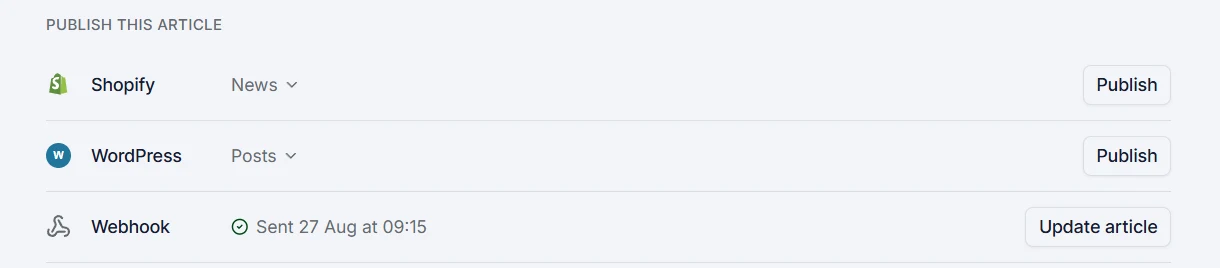
The article arrives with its product links in place and the images where they belong, so the shopper who just read why is one click from the thing itself.
Articles come out in English, Dutch or Czech, so a shop selling in Dutch publishes in Dutch.
The LinkedIn, X and Instagram versions come out of the same brief, written for how each one reads. Those are yours to post when you choose. We write them; we do not post them for you.
Before it publishes
Six checks, and they matter more when the article is doing sales work
Get a feeding amount or an ingredient wrong and a reader acts on it, on an animal that cannot tell them it was wrong. That is the part of this category worth being careful about, and it is why the checks below are not a formality here.
Search
It targets a question people actually type, and it is built to rank for it.
AI answers
Shoppers now ask assistants what to buy. The article is structured so those systems can quote it.
Brand voice
It sounds like your shop, checked against rules you set once rather than re-explained every time.
Machine tells
Hedging, filler and the giveaway phrasing are removed before the draft reaches you.
Brief compliance
It covers what the brief said it would, rather than drifting somewhere easier to write.
Learnings
Corrections you made last month are applied this month, so you stop repeating yourself.
On the self-serve plans you approve the outline before writing starts and read the draft before it publishes. Nothing goes into your store that you have not seen. See every step up close.
It does not invent a number about your products: figures come from the brief you approve or from a source the article names.
Proof
Read something it made and judge for yourself
We are not going to show you another shop and tell you what it earned. What we can show you is our own work. Every article on this blog came out of the same system this page is describing: researched, written, checked, and published, then read and approved by a person before it went out.
The subject is marketing rather than skincare or brake discs, because that is what we sell. Read one anyway and answer the only question a sample can settle: is this the standard you would put your shop's name on?
Read the blogQuestions worth asking first
- Will the articles hand out veterinary advice?
- No, and a good pet article does not try to. cpywrk writes to the brief you approve, so the brief sets how far an article goes and where it stops. The shape that works is a straight answer to the question, with the point named where an owner should call a vet instead. Make that a standing rule once and the brand voice check grades every draft against it.
- We sell for dogs, cats and small animals. Will it keep them straight?
- Yes. Every article is written to a brief that names the species, the life stage and the products in scope, and you approve that brief before writing starts. That is also where drift gets caught: if an outline about kitten feeding starts borrowing from dog advice, you see it as a heading rather than as a paragraph in a finished draft.
- Most of our revenue is repeat food orders. What is a blog for?
- The first order. Someone choosing food for a new puppy, or for a dog that has just started reacting to the old bag, is picking a supplier they may stay with for years, and they are searching before they pick. A product page rarely reaches that moment. An article that answers the question they typed can.
Selling something else
- Beauty
- Apparel
- Home & garden
- Wellness & supplements
- Fitness & outdoor
- Food & drink
- Toys & kids
- Jewellery
- Electronics
- Arts & crafts
- Auto parts
Or start from what content has to do for any webshop.
Run one article on your shop and see
You bring the topic, approve one outline and read one draft. The research, the writing, the checks and the publishing happen without you, and if the draft misses, you send it back: revisions are unlimited and cost nothing from your plan.
Start free trialOne full article free. No card required, no time limit.
Would rather not run it yourself? We can run it for you.