Nobody swallows a maybe.
Answer the second question.
A supplement search starts at the ingredient, and that is the easy part. The sale turns on what comes next: whether it works, how much to take, in which form, and whether it is safe with what they already take.
Written for shops where the person packing the orders is also the person who would write the blog.
One full article free. No card required, no time limit.

What actually works
The ingredient is the easy search. The sale is in the four after it.
The first search names the ingredient. The ones that decide the sale come after it: "magnesium glycinate vs citrate", "magnesium glycinate for sleep", "how much ashwagandha per day", "how long does creatine take to work", "best probiotic for bloating", and the one nobody wants to ask a person out loud, whether they can take it alongside what is already in the cupboard. The pattern behind those searches is consistent: a social feed pushes the awareness, and the search box is where the intent shows up. Somebody who heard about glycinate in a video checks it in a search before they buy it.
Somebody who lands from those searches has been sold to already and believes about half of it. Enthusiasm does not move them. Specifics do: which form you stock and why that one, what is actually in a capsule, what the research measured and in whom, how long people give it before deciding, and who should leave it alone. The article that tells a reader this one is not for them is what makes the next one believable.
Reaches a buyer
- Which form of an ingredient you stock, and why that one
- How much a day, and what the studies behind it actually used
- How long before anything is noticeable, said honestly
- What not to take it alongside, prescriptions included
Reaches nobody
- A piece about immunity that never names an ingredient
- New year, new you, posted on 2 January
- A press release about a study, lightly reworded
- A stack that happens to contain everything you sell
The good news is that the list is short and it repeats. Every ingredient you sell has the same four questions hanging off it, which makes this a publishing schedule rather than a brainstorm. That matters in a week where the only writing time you had went on an email asking whether it clashes with a prescription.
What the article has to answer
Four questions, and one article has to take all four
A definition is table stakes. The article that earns the sale keeps going long after it, because this reader has four more questions and stops at the first one you dodge. Written for the person still deciding whether to take the thing at all, not for the one already holding your bottle.
They arrive in roughly this order:
- Does it work?
- What the research supports, in whom, and where it stops. Cited rather than implied. This reader has already found the sceptical thread and knows the weak spots, so an article that steps around them loses to it.
- How much?
- The useful answer is not one number. It says what the studies used, how people usually split it, and where to ask a professional first. It is also the paragraph an assistant lifts, which is what the AI answers check grades.
- Which form?
- "Magnesium glycinate vs citrate" is an article in itself: what each one is for, how they differ in practice, and which one you carry. Naming the form you do not sell is what makes the recommendation credible.
- Can I take it with what I already take?
- The question nobody types into a shop's search bar and everybody types into Google. Answering it plainly, including the places where the answer is to ask a pharmacist, keeps the reader on your page instead of a forum.
Supplement claims are regulated. In the EU, Regulation 1924/2006 decides which nutrition and health claims may appear at all, and the authorised list is short and specific. cpywrk does not check regulatory compliance and does not claim to. It does not know which claims are cleared for your products in your market, and it should not be trusted to. You have two places to act on it: the outline you approve before writing starts, and the draft you read before it publishes. A claim is far easier to remove while it is still a heading. The article's job is to answer the question in front of it, not to promise the reader an outcome.
Where it ends up
An article in a document has never sold anything
The choice between glycinate and citrate takes one article to settle and about a minute to act on. A comparison that names neither bottle spends that minute on somebody else's site. cpywrk publishes the finished article onto your store, beside the two products it compared.

Shopify, direct
Connect the store once. After that it is one button: press Publish and the article is live on your store, formatted.

WordPress, direct
Same again if your shop runs on WooCommerce, or its blog runs on WordPress. Connected once, then the same single button sends it.

Webflow, direct
Running the shop or its blog on Webflow? Connect the site once and pick the collection the articles land in. After that, the same single button sends it.
Anything else, by webhook
On any other platform, the webhook hands the finished article to whatever you do run.
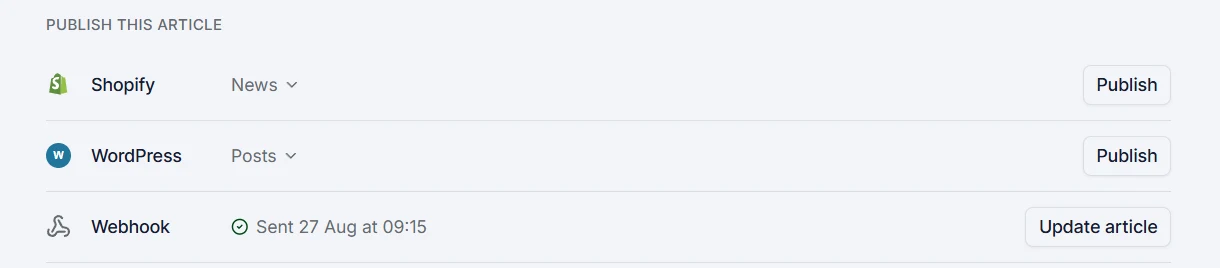
The article arrives with its product links in place and the images where they belong, so the shopper who just read why is one click from the thing itself.
Articles come out in English, Dutch or Czech, so a shop selling in Dutch publishes in Dutch.
The LinkedIn, X and Instagram versions come out of the same brief, written for how each one reads. Those are yours to post when you choose. We write them; we do not post them for you.
Before it publishes
Six checks, and they matter more when the article is doing sales work
An article that gets a dose or an interaction wrong is not a typo you fix next week. The reader was about to swallow it, sometimes on top of something a doctor prescribed, and a shop that is loose about that once does not get asked again. On this shelf a padded paragraph and a hedge are the two failures that cost you the reader, and the checks below take out both.
Search
It targets a question people actually type, and it is built to rank for it.
AI answers
Shoppers now ask assistants what to buy. The article is structured so those systems can quote it.
Brand voice
It sounds like your shop, checked against rules you set once rather than re-explained every time.
Machine tells
Hedging, filler and the giveaway phrasing are removed before the draft reaches you.
Brief compliance
It covers what the brief said it would, rather than drifting somewhere easier to write.
Learnings
Corrections you made last month are applied this month, so you stop repeating yourself.
On the self-serve plans you approve the outline before writing starts and read the draft before it publishes. Nothing goes into your store that you have not seen. See every step up close.
It does not invent a number about your products: figures come from the brief you approve or from a source the article names.
Proof
Read something it made and judge for yourself
We are not going to show you another shop and tell you what it earned. What we can show you is our own work. Every article on this blog came out of the same system this page is describing: researched, written, checked, and published, then read and approved by a person before it went out.
The subject is marketing rather than skincare or brake discs, because that is what we sell. Read one anyway and answer the only question a sample can settle: is this the standard you would put your shop's name on?
Read the blogQuestions worth asking first
- Can it write about dosage without drifting into medical advice?
- You draw that line in the brief and cpywrk writes to it. You say what the article may state, what has to be attributed to research, and where it defers to a doctor or a pharmacist. It does not invent a number it was not given. Anything it needs and does not have shows up in the outline, which is where you supply it or cut the section.
- Does it cite the research, or does it just say that studies show?
- It attributes. The AI answers check looks at whether the paragraph holds up when an assistant quotes it on its own, source included. If there is a specific paper you want the article to rest on, put it in the brief, and check the outline names it before writing starts.
- How do the EU health claims rules affect what it writes?
- They constrain the article, and cpywrk does not police them. It has no way to know which claims are authorised for your products in your market, so it writes to the brief you approved and shows you the draft before anything publishes. Those two gates are where a claim you cannot make gets removed.
Selling something else
- Beauty
- Apparel
- Home & garden
- Fitness & outdoor
- Pets
- Food & drink
- Toys & kids
- Jewellery
- Electronics
- Arts & crafts
- Auto parts
Or start from what content has to do for any webshop.
Run one article on your shop and see
You bring the topic, approve one outline and read one draft. The research, the writing, the checks and the publishing happen without you, and if the draft misses, you send it back: revisions are unlimited and cost nothing from your plan.
Start free trialOne full article free. No card required, no time limit.
Would rather not run it yourself? We can run it for you.