Nobody searches for a toy.
They search for a three-year-old.
The person buying is almost never the person playing with it. They type an age, a milestone or an occasion, and the shop that has already written that answer is the one they open.
Written for shops where the person packing the orders is also the person who would write the blog.
One full article free. No card required, no time limit.

What actually works
The query starts with an age and ends with a date
A parent does not type your category names. They type the child: best toys for a 3 year old, best baby carrier for newborns, when can a baby use a high chair, safe sleep for a newborn. The age or the milestone comes first, and an occasion is usually sitting behind it. A birthday, a christening, a baby shower, the last fortnight before Christmas. Your shop is sorted by wooden toys, ride-ons and puzzles, and none of that is what anybody searched.
That gap is yours to close, because the person searching usually knows the child better than they know the products. An aunt buying for a nephew she sees twice a year knows he is four. She does not know which sets lose half their pieces in a week, or what a four-year-old has already outgrown. You hear that back from customers all year. An article that answers the age question in your words and ends at three things you stock is doing sales work. A post announcing that a new range has landed is not.
Reaches a buyer
- What suits one age, and what that age has already outgrown
- A birthday guide for one age, at three price points
- How to choose a car seat, in the order the decision is actually made
- When a child is ready for the next stage, and how you can tell
Reaches nobody
- A round-up of this season's toy trends
- The new range has landed, with photographs
- A think piece with nothing a parent can act on
- A gift guide so broad it suits every age and nobody
You do not have to guess which ages carry the demand. cpywrk checks what people in your part of the market are searching before anything is briefed, and the brief that comes back names the age, the question behind it, and the products the article should end at. You approve that before a word is written.
The age-gated guide
One age in the title, four jobs in the article
The format that does the work in this category names an age or a stage in its title and answers everything that follows from it: best toys for a 3 year old, best baby carrier for newborns, how to choose a stroller for city living. It is a narrow promise, and that is the point. A guide to gifts for children competes with every magazine in the country. A guide for one three-year-old competes with almost nobody.
One of those guides has to hold four things at once, and they pull against each other:
- The stage
- What a child that age can actually do, stated early, because every decision the reader makes next hangs off it. The age on the box and the child in the room do not always agree.
- The safety line
- Age grading, small parts, weight limits, what a newborn should not be doing yet. Near the top and in plain words, taken from the product information you put in the brief.
- The occasion
- Most of these readers have a date in their head. The guide is written for somebody deciding today, so it ends in a shortlist rather than a shrug.
- The person buying
- Often a grandparent or a friend who knows the age and nothing else. No jargon, no developmental theory, three options instead of the whole category.
Safety information is not ours to give. Age grading, small parts warnings, weight limits and standards marks come from the manufacturer and from your own compliance work, and cpywrk does not know which of your products carry which. You do. That is what the outline gate is for: at that point a wrong age band is still a heading, which is the cheapest place in the whole process to catch it, and you read the draft before anything publishes.
Where it ends up
An article in a document has never sold anything
A birthday is a deadline. Somebody shopping for a two-year-old on a Tuesday has a party on Saturday, and they will buy from whichever shop answered the question while they were still reading it. cpywrk finishes the article and puts it on the store, so the answer is live while the date is still ahead of them.

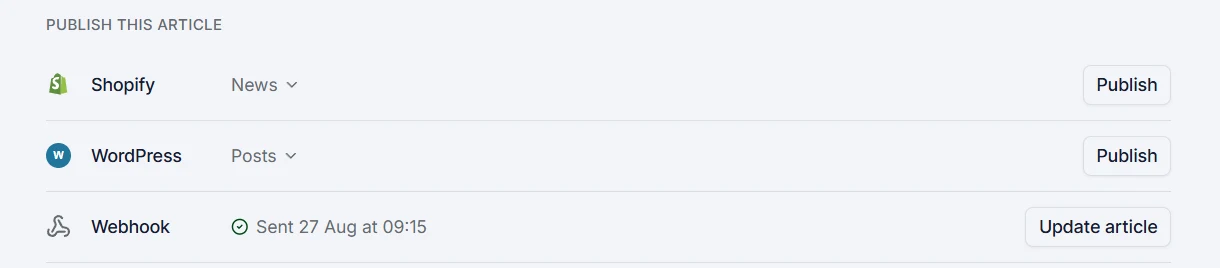
Shopify, direct
Connect the store once. After that it is one button: press Publish and the article is live on your store, formatted.

WordPress, direct
Same again if your shop runs on WooCommerce, or its blog runs on WordPress. Connected once, then the same single button sends it.

Webflow, direct
Running the shop or its blog on Webflow? Connect the site once and pick the collection the articles land in. After that, the same single button sends it.
Anything else, by webhook
On any other platform, the webhook hands the finished article to whatever you do run.
The article arrives with its product links in place and the images where they belong, so the shopper who just read why is one click from the thing itself.
Articles come out in English, Dutch or Czech, so a shop selling in Dutch publishes in Dutch.
The LinkedIn, X and Instagram versions come out of the same brief, written for how each one reads. Those are yours to post when you choose. We write them; we do not post them for you.
Before it publishes
Six checks, and they matter more when the article is doing sales work
The reader is buying for a child, which leaves very little room for a wrong detail. Recommend something for the wrong age band and you have not lost a sale, you have lost a parent, and parents tell each other. That is a narrow margin, and it is the reason every draft goes through the checks below before it is shown to you.
Search
It targets a question people actually type, and it is built to rank for it.
AI answers
Shoppers now ask assistants what to buy. The article is structured so those systems can quote it.
Brand voice
It sounds like your shop, checked against rules you set once rather than re-explained every time.
Machine tells
Hedging, filler and the giveaway phrasing are removed before the draft reaches you.
Brief compliance
It covers what the brief said it would, rather than drifting somewhere easier to write.
Learnings
Corrections you made last month are applied this month, so you stop repeating yourself.
On the self-serve plans you approve the outline before writing starts and read the draft before it publishes. Nothing goes into your store that you have not seen. See every step up close.
It does not invent a number about your products: figures come from the brief you approve or from a source the article names.
Proof
Read something it made and judge for yourself
We are not going to show you another shop and tell you what it earned. What we can show you is our own work. Every article on this blog came out of the same system this page is describing: researched, written, checked, and published, then read and approved by a person before it went out.
The subject is marketing rather than skincare or brake discs, because that is what we sell. Read one anyway and answer the only question a sample can settle: is this the standard you would put your shop's name on?
Read the blogQuestions worth asking first
- We sell for newborns up to about eight. Does that mean one article per age?
- No. Most shops get further with a small set of guides on the ages and milestones that carry real search demand, kept current as the range changes, than with one post per year of childhood. cpywrk researches which of those ages people are actually searching before it briefs anything, so you write for the ones with demand behind them rather than the ones your catalogue happens to be sorted by.
- Most of our year happens in November and December. When should the articles be written?
- Long before then. A gift guide published in the third week of November is chasing a window that is already closing. Writing through the quiet months and refreshing the same guides in early autumn is the shape that works, and it is the argument for a system that keeps producing in June, when nobody feels like it.
- Will it get the age recommendations right?
- It writes what your brief says. Age grading and safety warnings come from the manufacturer and from your own compliance work, and cpywrk has no way to know which of your products carry which. What it gives you is two places to catch a mistake before a customer sees it: the outline you approve before writing starts, and the draft you read before it publishes.
Selling something else
- Beauty
- Apparel
- Home & garden
- Wellness & supplements
- Fitness & outdoor
- Pets
- Food & drink
- Jewellery
- Electronics
- Arts & crafts
- Auto parts
Or start from what content has to do for any webshop.
Run one article on your shop and see
You bring the topic, approve one outline and read one draft. The research, the writing, the checks and the publishing happen without you, and if the draft misses, you send it back: revisions are unlimited and cost nothing from your plan.
Start free trialOne full article free. No card required, no time limit.
Would rather not run it yourself? We can run it for you.