The catalogue says it fits.
The article shows the job.
Nobody buys a wheel bearing for the fun of it. Your buyer searches the noise, the symptom and the repair long before they search a shop, and whoever explains the job is who they order the parts from.
Written for shops where the person packing the orders is also the person who would write the blog.
One full article free. No card required, no time limit.

What actually works
Two questions, and only one of them is an article
A parts buyer types one of two things. Either they are checking a fit ("does this fit a 2018 Golf", "front discs Transit Custom 2015"), or they are trying to get a job done ("how to replace a wheel bearing", "why does my steering wheel shake at 90", "what tools do I need for rear pads"). The first is a database question in the clothes of a sentence. Your catalogue already answers it, and no article should try.
The second question is the one worth writing for, and it is rarely about a single part. Somebody doing a wheel bearing also needs the seals, the fasteners and possibly a tool they do not own, and they buy all of it from whoever just explained the job. People buy a great many vehicle parts online, so the searches exist. What is usually missing is a shop that answers them.
Reaches a buyer
- How to do one repair, with everything the job consumes
- One symptom, its likely causes, in the order to check them
- Two parts that look identical, and why one lasts twice as long
- What else to change while the job already has it apart
Reaches nobody
- A service-interval table copied out of the manufacturer's handbook
- A history of the brand you distribute
- New model launches nobody needs parts for yet
- "Will this fit my car", which is a lookup and not an article
The winners in this category are unglamorous. The service part that fails on schedule. The job every owner of one engine faces eventually. The fault that sends people to a forum thread from 2014, because nobody with the parts on a shelf ever wrote it down. cpywrk works out which of those your buyers search before it writes anything, so every article on your blog is answering somebody. Writing them was never going to beat the trade counter and the courier cut-off. Between the outline you approve and the draft you read, it happens without you.
The article that sells parts
One repair, every part it takes, each one linked
The format is the repair how-to, written for somebody about to do the job rather than somebody reading about it. It names the symptom in the owner's words, narrows the cause, lists what the job consumes, then walks the steps in order. Every part in that list is a link into your shop, because the reader needs all of them in one order, today.
A guide that works has four parts, and the reader lands on a different one depending on what they typed:
- The symptom
- "grinding when I turn left". Nothing is diagnosed yet, so the article opens in the words an owner would use rather than the words on your invoice.
- The likely causes
- Two or three candidates, ranked, with the check that tells them apart. A shop that gets this right is trusted before it has mentioned a product.
- What the job takes
- Parts, consumables and tools: the seals, the fluids, the single-use fasteners, the socket nobody owns. Each one links into your catalogue, which is the part of the article that is doing the selling.
- The job itself
- The steps in order, the figures from your documentation set out as figures, and a straight line about where this stops being a driveway job.
The symptom explainer is the same article turned around. "Why is my brake pedal soft" is one question with several answers, and every answer is a part you stock. The reader arrives worried and leaves with a shortlist. The search check keeps the question in the words people actually type; the AI answers check makes the causes quotable, which is how your shop turns up when somebody asks an assistant instead of a search box.
Two things this page will not pretend. Fitment is data, not prose. It lives in your catalogue and in the lookup you have already built, it moves every time a supplier feed does, and an article should never try to answer "will it fit my car". It should hand the reader to the lookup and get out of the way. And the numbers are yours: torque values, fluid specifications and the safety steps around a jack come from the manufacturer's documentation, and cpywrk has them only because you put them in the brief. It does not carry a torque table and should not be trusted as one. You do that part, and you approve the outline before a word is written.
Where it ends up
An article in a document has never sold anything
Your reader is on the driveway with a wheel off, or about to be. They are on a phone, with dirty hands, and what they want next is the step after this one and the part it needs. cpywrk publishes it to the store finished, alongside the parts the job takes.

Shopify, direct
Connect the store once. After that it is one button: press Publish and the article is live on your store, formatted.

WordPress, direct
Same again if your shop runs on WooCommerce, or its blog runs on WordPress. Connected once, then the same single button sends it.

Webflow, direct
Running the shop or its blog on Webflow? Connect the site once and pick the collection the articles land in. After that, the same single button sends it.
Anything else, by webhook
On any other platform, the webhook hands the finished article to whatever you do run.
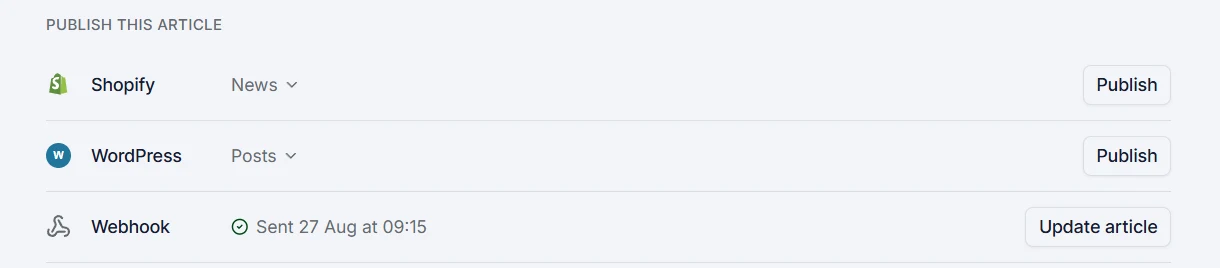
The article arrives with its product links in place and the images where they belong, so the shopper who just read why is one click from the thing itself.
Articles come out in English, Dutch or Czech, so a shop selling in Dutch publishes in Dutch.
The LinkedIn, X and Instagram versions come out of the same brief, written for how each one reads. Those are yours to post when you choose. We write them; we do not post them for you.
Before it publishes
Six checks, and they matter more when the article is doing sales work
In most categories a wrong detail costs you a return. Here a wrong torque figure or the wrong part number puts somebody under a car on the strength of what you published. There is no safe, approximate version of a repair guide, and the checks below exist to keep one off your store.
Search
It targets a question people actually type, and it is built to rank for it.
AI answers
Shoppers now ask assistants what to buy. The article is structured so those systems can quote it.
Brand voice
It sounds like your shop, checked against rules you set once rather than re-explained every time.
Machine tells
Hedging, filler and the giveaway phrasing are removed before the draft reaches you.
Brief compliance
It covers what the brief said it would, rather than drifting somewhere easier to write.
Learnings
Corrections you made last month are applied this month, so you stop repeating yourself.
On the self-serve plans you approve the outline before writing starts and read the draft before it publishes. Nothing goes into your store that you have not seen. See every step up close.
It does not invent a number about your products: figures come from the brief you approve or from a source the article names.
Proof
Read something it made and judge for yourself
We are not going to show you another shop and tell you what it earned. What we can show you is our own work. Every article on this blog came out of the same system this page is describing: researched, written, checked, and published, then read and approved by a person before it went out.
The subject is marketing rather than skincare or brake discs, because that is what we sell. Read one anyway and answer the only question a sample can settle: is this the standard you would put your shop's name on?
Read the blogQuestions worth asking first
- Can it write fitment content?
- No, and it should not. Fitment is data: which part number suits which model, year and engine code, changing every time a supplier feed does. That belongs in your catalogue and your lookup, where it can be maintained. cpywrk writes the repair and symptom side of the category, and sends the reader to your lookup for the fit.
- Where does a finished guide land, and does it touch our fitment lookup?
- It lands on the store and it leaves the lookup alone. Connect Shopify once and a finished article goes live from one button, formatted. WordPress and Webflow work the same way, which covers most shops running the blog separately from the storefront. On anything else, a webhook hands the finished article to whatever you do run. Fitment stays where it belongs: in your catalogue, answered by your lookup, and linked to from the guide rather than repeated in it.
- We sell parts for hundreds of models. Where does content even start?
- With jobs, not models. A guide to one repair serves every owner who has that repair ahead of them, and several fitments can sit inside one parts list. cpywrk researches which jobs your buyers actually search before anything is written, so the first ten articles are chosen rather than guessed.
- How do we stop an article giving advice that gets somebody hurt?
- Three things, and none of them is trusting the machine. Figures come from the documentation you put in the brief, not from anything the system thinks it knows. You approve the outline before writing starts, which is the cheapest moment to cut a section you would rather a professional handled. And a standing rule you set once applies to every article after it, including how safety kit is stated and when a job should be sent to a workshop.
Selling something else
- Beauty
- Apparel
- Home & garden
- Wellness & supplements
- Fitness & outdoor
- Pets
- Food & drink
- Toys & kids
- Jewellery
- Electronics
- Arts & crafts
Or start from what content has to do for any webshop.
Run one article on your shop and see
You bring the topic, approve one outline and read one draft. The research, the writing, the checks and the publishing happen without you, and if the draft misses, you send it back: revisions are unlimited and cost nothing from your plan.
Start free trialOne full article free. No card required, no time limit.
Would rather not run it yourself? We can run it for you.