Your buyer is weighing two options.
Settle it.
Fitness and outdoor buyers arrive with a constraint: a small flat, a wet trail, a first month of training, a fixed budget. The guide that settles the choice has to know both products, and that is the shop, not the publisher who has never sold either.
Written for shops where the person packing the orders is also the person who would write the blog.
One full article free. No card required, no time limit.

What actually works
The constraint is typed before the product
Nobody in this category searches for a product on its own. They search for it with the thing that rules most of the options out, which is a goal, a space, a level or a budget: "best treadmill for apartments", "home gym setup for small space", "adjustable dumbbells vs fixed", "gym gear for beginners". Outdoors the constraint is the activity and the conditions instead, and the shape is identical: "how to choose hiking boots", "trail running shoes vs hiking shoes", "best winter hiking boots", "lightweight backpacking tent under 2 kg". If you sell activewear rather than equipment, the queries lean on occasion and fit and the apparel page is the better read.
Those are searches a shop can win, because answering them takes product knowledge rather than exercise science. Anyone can explain that rowing is good for the back. Far fewer people can say which of the two rowers on your shelf folds flat against a wall, what it actually holds, and which one a downstairs neighbour will forgive at six in the morning. You can. A guide that answers the constraint straight and ends at one of your two options is doing sales work. A post about how much you love the sport is not.
Reaches a buyer
- How to choose a boot: the types, the fit, the terrain it is for
- What the spec sheet calls a maximum and what it holds in a flat with a neighbour below
- The best option when the room is small or the ceiling is low
- What to buy first, and what can wait until month three
Reaches nobody
- The 10 best ab exercises, where the medical publishers already sit
- Motivation tips for sticking to a new routine
- A training diary with no gear decision in it
- A best-of list with no constraint in the title
Which constraint an article should be built around is not a guess. cpywrk researches what your buyers type, in your market, before writing starts, so you end up with the comparison people are actually making rather than the one you happen to find interesting. The hour after closing goes on next season's order rather than on writing. You approve the outline and read the draft; the rest happens while you are on the shop floor.
The guide that does the work
Types, then fit, then the two you stock
You have had this conversation across the counter. Somebody wants a boot, you ask where they walk, and only then do you take two boxes off the shelf. That is the article. Types first, fit second, the two you stock last. Skip the first two and it reads as a catalogue, which is what most shop guides are.
-
The types
What the category is made of, named plainly, with who each type is for. Trail, approach and backpacking boots. Folding, manual and motorised treadmills. This is the part the reader arrives without, and the part a guide that opens with a recommendation never comes back to.
-
Fit and the parts that matter
The three or four things that change the decision, and a straight word about the ones that do not. Width and volume in a boot. Deck length, folded depth and what the frame is rated to in a treadmill. Written so the reader can measure their own situation against it rather than take your word for it.
-
The two you stock
Only now, and only the options the guide has already earned the right to recommend. Both linked, each with the reader it suits, so nobody has to scroll back up to work out which one is theirs. This is also the paragraph an assistant quotes when a shopper asks it the same question, which is what the AI answers check grades.
Worth being straight about the half of this market you are not going to take. The informational results belong to publishers: health and fitness media hold the workout and training searches, and retailers hold the buying ones. Nothing here is going to win you "home workout", and this page is not going to pretend otherwise. Your edge is the buying guide, where you know the product and they do not. cpywrk does not know the real maximum load of the rack on your shelf, how that boot sits on a wide foot, or which of the two tents you have actually pitched in weather. That is what goes into the brief you approve.
Where it ends up
An article in a document has never sold anything
The point of a how-to-choose guide is the sentence where the reader picks one. If the two products are not right there, linked and in stock, the pick moves to whoever did link them. cpywrk puts the finished guide on your store with both of them in it.

Shopify, direct
Connect the store once. After that it is one button: press Publish and the article is live on your store, formatted.

WordPress, direct
Same again if your shop runs on WooCommerce, or its blog runs on WordPress. Connected once, then the same single button sends it.

Webflow, direct
Running the shop or its blog on Webflow? Connect the site once and pick the collection the articles land in. After that, the same single button sends it.
Anything else, by webhook
On any other platform, the webhook hands the finished article to whatever you do run.
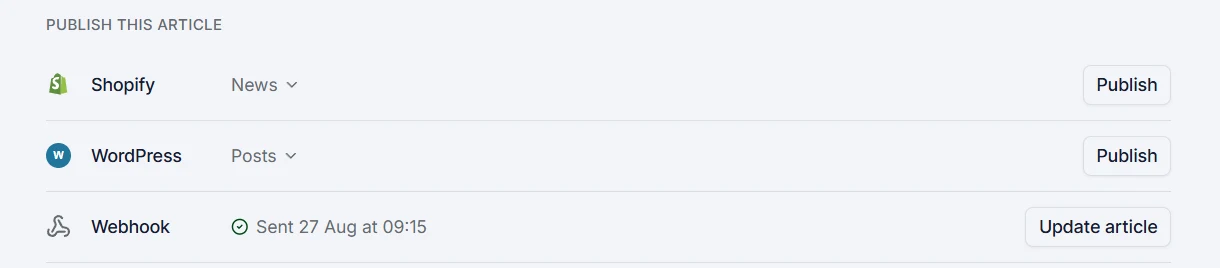
The article arrives with its product links in place and the images where they belong, so the shopper who just read why is one click from the thing itself.
Articles come out in English, Dutch or Czech, so a shop selling in Dutch publishes in Dutch.
The LinkedIn, X and Instagram versions come out of the same brief, written for how each one reads. Those are yours to post when you choose. We write them; we do not post them for you.
Before it publishes
Six checks, and they matter more when the article is doing sales work
Fitness and outdoor buyers read the numbers. Get a load rating, a pack weight or a shoe width wrong and a reader who owns the gear will correct you in public, in front of everyone else still deciding. Writing for somebody who already owns the gear is a higher standard than writing for somebody browsing, and the checks below are set to it.
Search
It targets a question people actually type, and it is built to rank for it.
AI answers
Shoppers now ask assistants what to buy. The article is structured so those systems can quote it.
Brand voice
It sounds like your shop, checked against rules you set once rather than re-explained every time.
Machine tells
Hedging, filler and the giveaway phrasing are removed before the draft reaches you.
Brief compliance
It covers what the brief said it would, rather than drifting somewhere easier to write.
Learnings
Corrections you made last month are applied this month, so you stop repeating yourself.
On the self-serve plans you approve the outline before writing starts and read the draft before it publishes. Nothing goes into your store that you have not seen. See every step up close.
It does not invent a number about your products: figures come from the brief you approve or from a source the article names.
Proof
Read something it made and judge for yourself
We are not going to show you another shop and tell you what it earned. What we can show you is our own work. Every article on this blog came out of the same system this page is describing: researched, written, checked, and published, then read and approved by a person before it went out.
The subject is marketing rather than skincare or brake discs, because that is what we sell. Read one anyway and answer the only question a sample can settle: is this the standard you would put your shop's name on?
Read the blogQuestions worth asking first
- Can the guides use our own product specs, like the load rating on a rack?
- Yes, from the brief you approve. You supply the figures and cpywrk builds the guide around them, researching what buyers ask about that spec and answering it. Specifications are never guessed. A gap turns up at the outline, before writing starts, so the load rating either gets supplied or the guide is written without that claim in it.
- We stock two brands that compete with each other. Can an article compare them honestly?
- Yes, and honest is the only version that works. You say in the brief which option suits which buyer and why, and the guide follows that rather than crowning a favourite. A comparison that lands on the same answer every time stops being useful, and readers work that out faster than you would like.
- Half our range is seasonal. Can the schedule follow the weather?
- You set the run of topics and cpywrk works to it, so the winter boot guide is written and live before the weather turns rather than in January. The research step starts from what people are searching now, which is often a season ahead of what you are shipping now.
Selling something else
- Beauty
- Apparel
- Home & garden
- Wellness & supplements
- Pets
- Food & drink
- Toys & kids
- Jewellery
- Electronics
- Arts & crafts
- Auto parts
Or start from what content has to do for any webshop.
Run one article on your shop and see
You bring the topic, approve one outline and read one draft. The research, the writing, the checks and the publishing happen without you, and if the draft misses, you send it back: revisions are unlimited and cost nothing from your plan.
Start free trialOne full article free. No card required, no time limit.
Would rather not run it yourself? We can run it for you.