The project comes first.
The materials list is your shop.
Craft buyers start with the thing they want to make, not with the materials it takes. Whoever explains how to make it writes the shopping list, and that shop should be yours.
Written for shops where the person packing the orders is also the person who would write the blog.
One full article free. No card required, no time limit.

What actually works
Nobody buys yarn. They buy a jumper they have not made yet.
Craft materials sell well online, and almost nobody arrives at them by typing a material. They type what they want to end up with: how to start cross stitch, best yarn for beginners, how much fabric a tote bag takes. Every one of those is somebody who has chosen a project and bought nothing yet.
A pattern site or a video can tell them how. It cannot tell them the pattern eats four skeins rather than three, that a DK substitution changes the drape, or which hoop size actually fits the design. You can, because you sell both and know which comes back. An article that gets somebody through a project has a materials list in it, and the materials list is your catalogue. A post announcing a new colourway is not.
Reaches a buyer
- One project, start to finish, with the whole materials list
- What to make first, and what to leave until you have practised
- How much of each material the project actually takes
- A substitution that works, and one that ruins the finish
Reaches nobody
- Ten craft trends for autumn
- Notes from the yarn show, written for the people who were already there
- The history of macramé, at length
- A gallery of finished pieces that never says how
cpywrk finds which projects people are already searching for near the things you stock, then builds the brief around one. The article exists because a maker went looking for it, and your catalogue is what it costs to finish. None of the writing lands on the evening you had set aside for winding skeins and answering pattern queries.
The project guide
A project they can finish, and a list they can buy
One finished thing, made once, explained by somebody who has made it. That is the format that carries a craft shop, and the only one where your products belong in the body of the article rather than bolted on at the end. Four parts do the work, and most shops leave out the fourth:
- Level and time
- In the first screen, because a maker decides whether to start before they decide what to buy. "A weekend, and you should have held a crochet hook" turns the wrong reader away on purpose.
- What it takes
- Weights, sizes, quantities, and how many of each. This is where your products go, linked, at the amount one project needs rather than the amount that fills a basket.
- The steps
- Numbered, in order, one action each, short enough to read with the work in your other hand. Structured so an assistant can quote one step back to whoever asked, which is what the AI answers check grades.
- The first mistake
- What goes wrong on a first attempt: the tension, the wrong side, the second coat applied too soon. Naming it is what makes a guide read like a maker wrote it.
A project guide lives on its photographs: the finished piece, the step where it stops looking like a mistake, the close-up of the stitch. cpywrk does not take those, and no article writes its way around a missing one. The photographs are yours to take and place, which is work, and worth saying so; the article is the words around them. The rest works the same way. cpywrk does not know how your merino behaves once it is blocked, which of your papers buckles under a wet wash, or what your own makers have tried and abandoned. That goes into the brief, where it belongs.
Where it ends up
An article in a document has never sold anything
Cross stitch takes a hoop, fabric, floss and a needle, and a first-timer wants all four in one basket rather than six searches through your catalogue. That list belongs inside the article, on the site that stocks it. cpywrk finishes the guide and publishes it to your shop.

Shopify, direct
Connect the store once. After that it is one button: press Publish and the article is live on your store, formatted.

WordPress, direct
Same again if your shop runs on WooCommerce, or its blog runs on WordPress. Connected once, then the same single button sends it.

Webflow, direct
Running the shop or its blog on Webflow? Connect the site once and pick the collection the articles land in. After that, the same single button sends it.
Anything else, by webhook
On any other platform, the webhook hands the finished article to whatever you do run.
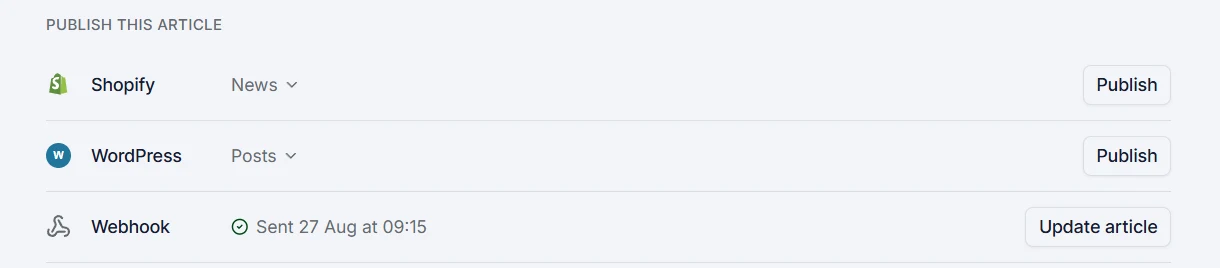
The article arrives with its product links in place and the images where they belong, so the shopper who just read why is one click from the thing itself.
Articles come out in English, Dutch or Czech, so a shop selling in Dutch publishes in Dutch.
The LinkedIn, X and Instagram versions come out of the same brief, written for how each one reads. Those are yours to post when you choose. We write them; we do not post them for you.
Before it publishes
Six checks, and they matter more when the article is doing sales work
A project guide that gets a quantity wrong wastes a customer's Saturday and their money, and makers tell each other. A guide that talks around the number is barely better than one that gets it wrong, and the checks below are set against that kind of writing.
Search
It targets a question people actually type, and it is built to rank for it.
AI answers
Shoppers now ask assistants what to buy. The article is structured so those systems can quote it.
Brand voice
It sounds like your shop, checked against rules you set once rather than re-explained every time.
Machine tells
Hedging, filler and the giveaway phrasing are removed before the draft reaches you.
Brief compliance
It covers what the brief said it would, rather than drifting somewhere easier to write.
Learnings
Corrections you made last month are applied this month, so you stop repeating yourself.
On the self-serve plans you approve the outline before writing starts and read the draft before it publishes. Nothing goes into your store that you have not seen. See every step up close.
It does not invent a number about your products: figures come from the brief you approve or from a source the article names.
Proof
Read something it made and judge for yourself
We are not going to show you another shop and tell you what it earned. What we can show you is our own work. Every article on this blog came out of the same system this page is describing: researched, written, checked, and published, then read and approved by a person before it went out.
The subject is marketing rather than skincare or brake discs, because that is what we sell. Read one anyway and answer the only question a sample can settle: is this the standard you would put your shop's name on?
Read the blogQuestions worth asking first
- If we give the project guide away for free, are we giving away the sale?
- The instructions are not what you sell. The materials are, and somebody following your steps needs all of them at once. Without a guide, that same maker learns it from a video and buys the yarn wherever the video sent them. You are giving away a reason to buy from you.
- Can it be trusted with quantities? A wrong yardage costs the customer money.
- It writes to the brief you approve, and it does not invent product facts. The outline comes to you before a word is written, so a yardage you have not given is a question, never a guess.
- Does it publish into our Shopify blog, or do we still paste it in ourselves?
- It publishes. Connect the store once, and every article after that goes live at one press of Publish, formatted. WordPress and Webflow connect the same way. On any other platform, a webhook hands the finished article to whatever you do run.
- Our customers range from complete beginners to people who have done this for twenty years. Can one blog serve both?
- Yes, one guide at a time. Skill level is part of the brief, so a guide written for a first attempt says so in its opening lines instead of hedging towards everybody. The brand voice check keeps the whole shelf sounding like one shop.
Selling something else
- Beauty
- Apparel
- Home & garden
- Wellness & supplements
- Fitness & outdoor
- Pets
- Food & drink
- Toys & kids
- Jewellery
- Electronics
- Auto parts
Or start from what content has to do for any webshop.
Run one article on your shop and see
You bring the topic, approve one outline and read one draft. The research, the writing, the checks and the publishing happen without you, and if the draft misses, you send it back: revisions are unlimited and cost nothing from your plan.
Start free trialOne full article free. No card required, no time limit.
Would rather not run it yourself? We can run it for you.