For professional services
Content that earns the first meeting.
Nothing publishes without you.
Your firm already knows the answers. The problem is that the only people who could write them down are the ones you bill by the hour.
One full article free. No card required, no time limit.

What actually works
Nobody buys advice from a blog post. They decide who to call.
A shop writes to be found at the moment somebody is deciding what to buy, and the sale happens on the page. A firm writes to be the reason somebody picks up the phone, and then to still be standing when they read three more of your pieces before the meeting.
That changes what is worth writing. The questions a client asks you in a first meeting are the questions they typed into a search box the week before. Answer those in public, with the same directness you would use in the room, and you are having the meeting early. Publish a note about the firm and you are talking to people who already know you.
Earns the call
- The question every client asks in the first meeting
- What a piece of work costs, and what moves the number
- How to choose between two approaches that sound identical
- The mistake you keep being called in to fix
Reaches nobody
- A note about the new office or the new hire
- Ten predictions for the year ahead
- A summary of last week's rule change, aimed at nobody in particular
- Anything written because it was somebody's turn
Which of those questions people actually search for is not a guess. cpywrk researches it before anything is written, so the article exists because somebody is already looking for the answer.
By practice
Two practices with a page of their own
An accountancy practice and a law firm share the job on this page and then part ways. One sells before a deadline the whole country can see coming; the other sells when something has already gone wrong. Each has its own page: what its clients search, the one article shape that does the work, and the part of the product that only matters there.


Why it never happens
The only people who could write it are the ones you bill out
Every firm has the same plan, and it loses to client work every week. That is the right call each individual time. It is a bad outcome over two years, and it is why the insight that would have won you the enquiry is still sitting in a partner's head.
So you price an agency. The bill is a familiar kind of purchase for a firm that sells its own time. What tends not to survive is everything around it: months of onboarding, a brief re-explained from scratch every time, and the knowledge of how your firm actually thinks living inside somebody else's account.
cpywrk keeps it in your account instead. Standing rules, the corrections you made last month, how you refer to your own work: set once, applied to everything after. It builds up somewhere you can still reach when you stop paying for it.
Set against that, cpywrk is a monthly subscription with the knowledge staying in your account, and no agency rate attached to it.
What it needs from a partner
You give it the question and what the firm knows about it, approve the outline before anything is written, and read the draft before it goes live. Those are the moments the article needs somebody senior. Everything between them happens without the firm, and if a draft misses, it goes back for as many revisions as it takes at no cost to your plan.
Before it publishes
You approve the outline before a word is written
The real objection is not whether a machine can write. It is whether you would put the firm's name on what it wrote. So the answer is structural rather than reassuring: cpywrk shows you the angle, the outline, and what each section will argue, and nothing is written until you say yes. Then you read the draft before it goes live.
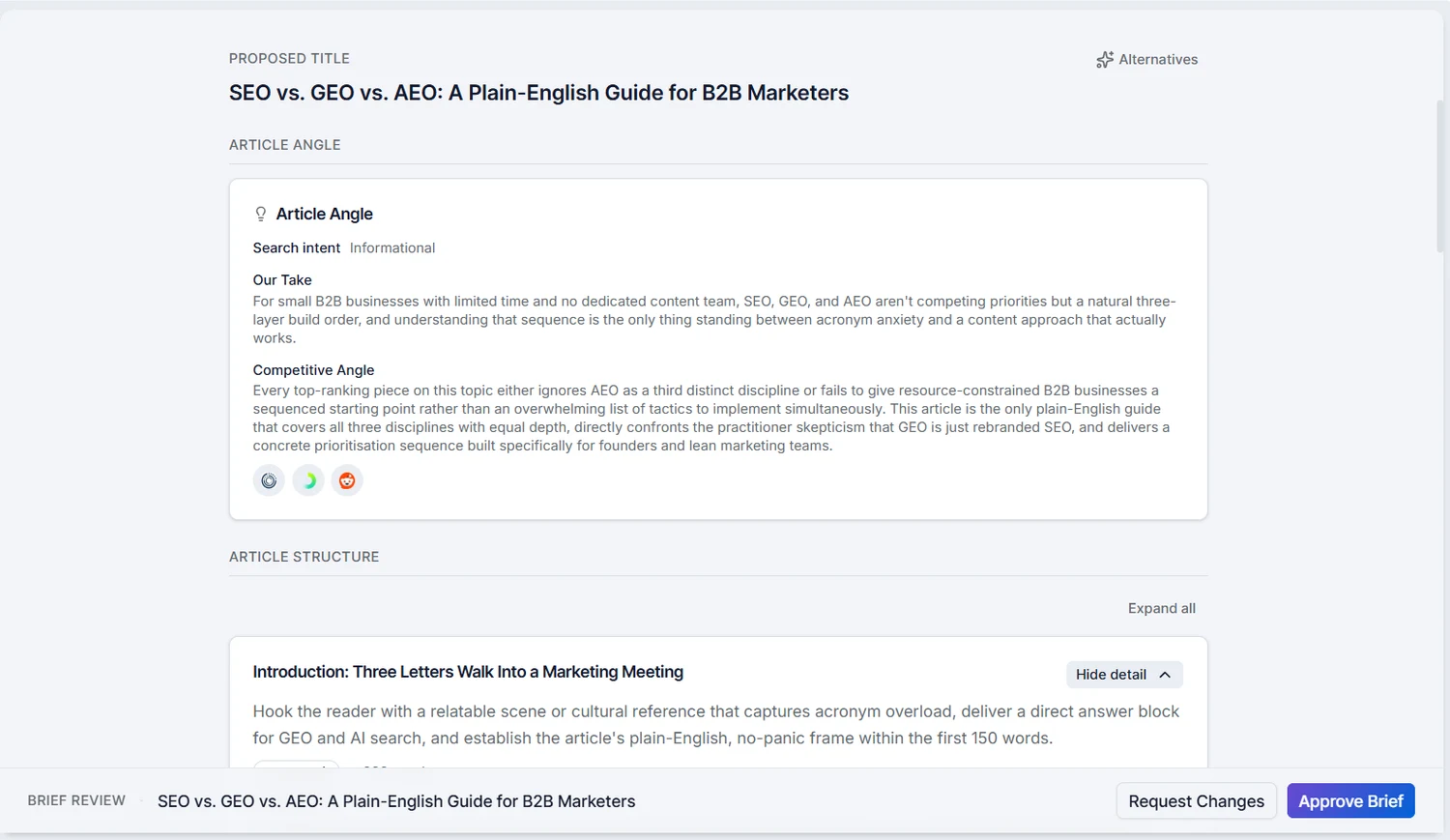
What it does not do is sign off your professional position. A quality check is not a compliance review, and cpywrk does not pretend to be your regulator. It gets the piece to the point where your review is quick. The review is still yours.
Every article is graded on six dimensions first
Search
It targets a question people actually type, and it is built to rank for it.
AI answers
Buyers now ask an assistant what a piece of work involves and who does it. The article is structured so those systems can quote it.
Brand voice
It sounds like your firm, checked against rules you set once instead of re-explaining them in every brief.
Machine tells
Hedging, filler and the phrasing that gives a machine away are stripped out before you read it.
Brief compliance
It argues what the outline said it would, rather than drifting somewhere easier to write.
Learnings
A correction you made in March is applied in April, so you stop giving the same note twice.
Each failing check shows you the passage and the fix. See every step up close.
Where it ends up
A finished article in a shared drive is not published
This is where most tools stop. You get a draft, and then somebody has to format it, find an image, write the meta description, add the internal links and get it into the CMS. That job lands on whoever has the password, on top of their actual work, which is how good drafts end up in a folder nobody opens.

WordPress, direct
Connect the site once. After that it is one button: press Publish and the article is live, formatted. Shopify connects the same way if you sell online too.

Webflow, direct
On Webflow, connect the site once and choose the collection the articles land in. After that it is the same single button.
Anything else, by webhook
On a bespoke site, or a CMS your developer chose, the webhook hands the finished article to whatever you do run.
Articles come out in English, Dutch, Czech or German.
The LinkedIn version comes out of the same brief, written for how LinkedIn reads, which matters more here than anywhere else your buyers spend time. It is yours to post when you choose. We write it; we do not post it for you.
Proof
Read something it made and judge for yourself
We are not going to show you another firm's numbers and ask you to trust them. What we can show you is our own work. Every article on this blog came out of the same system this page is describing: researched, written, checked, published, and read and approved by a person before it went out.
You are close to the reader they were written for, which makes this a fair test. Would you have put your name on it?
Read the blogQuestions worth asking first
- What should a professional services firm actually publish?
- The questions a client asks in a first meeting. People type those questions into a search box a week before they call you, and the firm that answered them is the firm they call. What a piece of work costs and what moves the number, how to choose between two approaches that sound identical, and the mistake you keep being called in to fix all reach somebody. Firm news and trend round-ups do not.
- Will it sound like our firm rather than like a machine?
- You set the rules once: how the firm talks about its work, what it does not claim, the words it never uses. cpywrk checks every article against them, and against the corrections you made on earlier pieces, so you stop giving the same note twice. A separate check strips out the hedging, filler and giveaway phrasing that make writing read as machine-made.
- We work in a regulated field. Does that rule this out?
- No, but be clear about what the system does. You approve the outline before a word is written and read the draft before it publishes, and standing rules you set once are applied to everything. What cpywrk does not do is sign off your regulatory position. A quality check is not a compliance review. That review stays with whoever holds it today.
- Can cpywrk publish into our WordPress site?
- Yes. Connect the site once, and after that publishing is one button: press Publish in cpywrk and the finished article is live, formatted. Shopify and Webflow work the same way. Any other CMS receives the article through a webhook.
Take one question you answer every week
Approve one outline, watch it move through all four steps, and judge the draft the way you would judge a junior's first attempt.
Start free trialOne full article free. No card required, no time limit.
Would rather not run it yourself? We can run it for you.