How to Choose a Content Marketing Service When You're Not a Content Expert
Not a content expert? This plain-English guide shows founders and lean marketing teams what to look for, what to ask, and the red flags to avoid.

There’s a scene in Ocean’s Eleven where Danny Ocean walks into the Bellagio vault room briefing for the first time. Everyone else at the table has done this before. They know the lingo, the tools, the risks. Danny’s supposed to be running the operation, but for about 30 seconds, he’s just a guy in a room full of specialists, trying to figure out which questions to ask without revealing how much he doesn’t know. That’s what it feels like to evaluate a content marketing service when you’ve never hired one before. You’re the founder. You’re supposed to be making the call. But the proposals all sound the same, and you’re not sure which promises are real.
Here’s the thing: most guides on how to choose a content marketing service assume you already speak the language. They’re written for marketing managers who can tell a content audit from a content calendar blindfolded. If you’re running a founder-led business or leading a lean marketing team without a content team, those guides aren’t for you. This one is.
You don’t need content expertise to choose well. You need 3 things: clarity on which provider model fits your situation, 6 specific questions to ask before signing anything, and the red flags that signal a bad fit. This guide gives you all 3 in plain English.
Choosing a content marketing service without content expertise comes down to matching the right provider model to your available time and budget, running a sample test before you commit, and watching for red flags like vague quality guarantees and unfavourable contract terms. This guide walks through the full framework, including what to look for, which questions to ask, and the modern evaluation criteria most guides still ignore.
What a Content Marketing Service Actually Does
A content marketing service produces content designed to drive organic growth: traffic, credibility, and leads that build over time without paid spend. The output typically includes blogs, landing pages, product content, and sometimes email or social posts.
The category is wider than most first-time buyers expect. Some providers handle strategy only. Others produce content but leave publishing and distribution to you. A few cover the full cycle from research through to a live page on your site. Content marketing services listed across top-ranking guides span blog writing, SEO strategy, social content, email newsletters, video scripts, landing pages, and content distribution, a range that illustrates why scoping what you actually need feels confusing before you’ve been through it once.
What a content marketing service typically does not include: paid advertising, web design, brand identity work, or PR. Unless those are explicitly listed as deliverables, don’t assume they’re part of the package. If you’re unsure which types of content your site actually needs, a practical starting point is understanding the pages your site actually needs before you brief a provider on anything else.
The goal here isn’t to memorise every service category. It’s to have enough working vocabulary that the rest of this guide makes sense.
Agency, Freelancer, or Software Service: Which One Fits a Lean Team
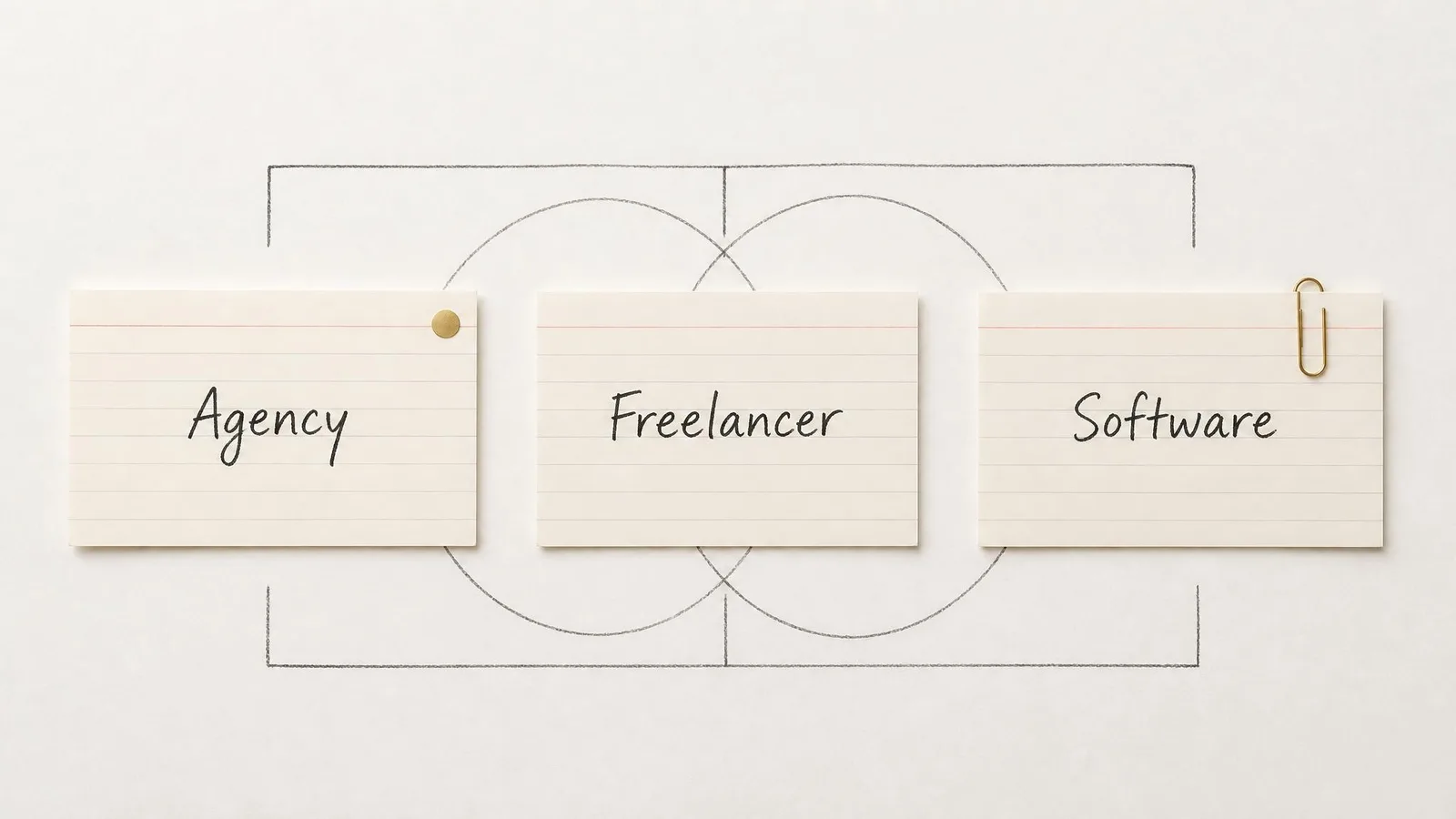
There are 3 main provider models for content marketing, and the right one depends less on your budget than on how much of your own time you can invest. Here’s how to evaluate content marketing services without expertise in the category itself: start with the model, not the provider.
Full-service agencies offer the broadest scope. They’ll handle strategy, production, and often distribution. The trade-off is cost and coordination. Agencies work best when someone on your side can manage the relationship, attend status calls, and review deliverables on a regular schedule. For founders who want to hand off content and forget about it, agencies are often a poor fit, not because the work is bad, but because the management overhead is real. If you’re weighing this option, it helps to understand how a content agency compares to other options.
Freelancer marketplaces are the lowest cost per piece, but they come with a different kind of overhead. You’re the project manager. You write the briefs, chase the deadlines, review the drafts, and handle revisions. Quality varies widely from one writer to the next, and voice drift is a consistent risk when you’re pulling from a large pool.
Software-enabled content services sit between the two. They use structured processes to deliver more predictable output with less management time than either an agency or a freelancer rotation. The question to ask with any software-enabled service is whether it keeps you in editorial control or removes you from the process entirely. Content production where you stay in the driver’s seat is a fundamentally different product than content production where someone else decides what gets published.
For founder-led businesses and lean marketing teams operating without a content team, the hidden cost that rarely appears in any pricing page is management time. Every hour you spend briefing, chasing, and editing is an hour you’re not spending on the business.
What to Look For in a Content Marketing Service When You’re Not an Expert
You don’t need a marketing degree to evaluate a content marketing service. You need 5 criteria, and every one of them is something you can assess yourself.
-
Brand voice fit. Before you commit, ask for a sample written specifically for your business. Not a portfolio piece. Not a case study from a different industry. A short piece on your topic, for your audience, in your voice. If it reads like it could’ve been written for anyone, it probably was. Brand-aligned content starts with a provider who’s willing to prove they can produce it. If you haven’t documented your voice yet, brand voice guidelines are worth creating before you evaluate anyone.
-
Editorial process transparency. A good content service should be able to explain, in plain English, how a brief becomes a published piece and who’s responsible for quality at each step. If the answer is vague or you get a wall of jargon, that tells you something about how the actual production will feel.
-
SEO and AI search readiness. Content that only targets traditional Google keyword rankings is increasingly incomplete. Ask whether the service produces AI-ready content, structured so it can be extracted and cited by tools like ChatGPT, Perplexity, and Google’s AI Overviews. A provider who can explain search and AI visibility in plain English is operating with a current understanding of how people find content in 2026.
-
Management overhead. Ask how much time per week you’ll realistically need to invest. Be sceptical of any provider who says the answer is zero. Content marketing for small business works best when the buyer stays engaged enough to steer direction, even if that’s only an hour a week.
-
Proof of outcomes. Look for evidence the service has produced content that ranks and content that converts for businesses similar to yours. High-quality content should be demonstrable, not just described. Ask for live URLs, not just PDFs.
Questions to Ask Before You Sign Anything

These are the questions to ask a content marketing agency before hiring, whether you’re talking to an agency, a freelancer, or a software-enabled service. Each one is designed to surface information that non-expert buyers typically don’t think to request.
- “Can you write a sample piece specifically for my business before we sign?” A provider confident in their quality won’t hesitate. One who deflects to existing portfolio work is avoiding the test. The sample doesn’t need to be long. It needs to sound like you.
- “How much time per week will I need to invest in this relationship?” The honest answer is never zero. Get a specific number so you can plan for it. If you’re told you won’t need to do anything, that’s worth questioning.
- “Who owns the content once it’s delivered, and what happens to it if I cancel?” Content ownership and IP assignment vary significantly across contracts. Some providers retain rights until full payment; others use work-for-hire language that transfers rights immediately. Read the clause, not the sales deck. For context on what content and SEO services typically cost, it helps to understand how pricing structures relate to deliverables and contract terms.
- “Do you produce AI-ready content, and can you show me an example?” If the answer is vague, or the provider hasn’t heard of search and AI visibility, that’s a meaningful signal about how current their approach is. AI-ready content isn’t a gimmick; it’s how content shows up in Google and AI answers.
- “How do you maintain brand voice consistency across multiple pieces and multiple writers?” Brand-aligned content requires a system, not just good intentions. A large writer pool with no editorial layer is one of the most common sources of voice drift. Your editorial judgment should be part of the process, not replaced by it.
- “What does the onboarding process look like, and what do I need to provide?” A structured answer signals a mature process. A vague answer signals improvisation. The quality of the onboarding usually predicts the quality of the output.
Red Flags That Signal a Bad Fit
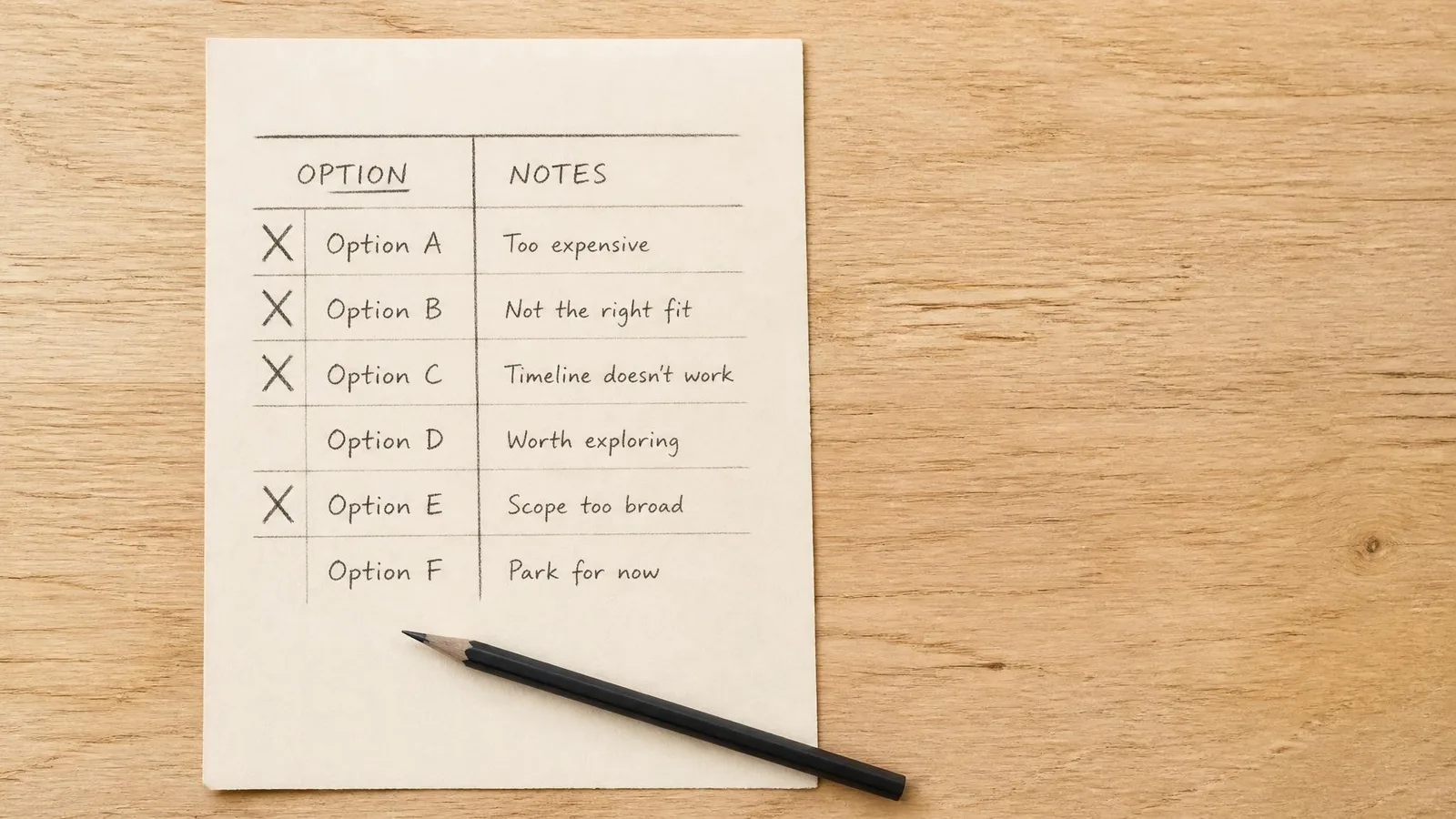
These are the red flags content marketing agency buyers should watch for. None of them require content expertise to spot.
-
They promise results on a specific timeline without asking about your starting point. Real-world results from content marketing depend on your existing content, your competitive landscape, and your audience. A provider who guarantees rankings within 90 days without asking a single question about your business is selling a timeline, not a strategy.
-
The quality guarantee is vague. Phrases like “we guarantee satisfaction” with no defined standard, no revision process, and no clear escalation path are not guarantees. Ask what happens concretely when the content isn’t right. If there’s no answer, there’s no process.
-
A large writer pool with no named editorial layer. If a service describes its model as “a network of thousands of writers,” ask who’s responsible for consistency and voice alignment on your account specifically. High-quality content at scale requires editorial oversight, not just writer volume.
-
Contracts with automatic rolling renewals or ambiguous ownership language. Minimum terms longer than 3 months for a new client, unclear termination clauses, and IP language that doesn’t explicitly transfer ownership to you on delivery are all worth questioning before you sign.
-
They optimise for word count or publishing frequency instead of usefulness. A service that leads with “we publish 20 posts a month” without explaining what those posts will cover or who they’re for is prioritising output over outcomes. Practical content that answers real questions will always outperform volume for volume’s sake.
-
No structured onboarding process. If a provider can’t explain clearly how they’ll learn your brand, your audience, and your goals before the first piece is written, the first piece will show it. Onboarding is where the relationship either starts well or starts sliding.
What You Need to Bring to the Relationship
There are 4 things every content service will need from you: a clear description of who your audience is and what they’re trying to solve, examples of your brand voice or existing content you like, a list of topics, questions, or product areas you want to cover, and an agreed approval workflow so content doesn’t sit in a queue waiting for sign-off.
You don’t need to write the briefs yourself. A good content service will have its own briefing process. But you do need to give it enough raw material to work from. If you’re not sure what your audience is searching for, a practical first step is to find the questions your audience is actually searching and bring those to the conversation.
The amount of input required varies by model. Full-service agencies typically need more ongoing involvement than software-enabled services with structured intake workflows. Neither is better in the abstract; what matters is that the level of involvement matches what you can actually sustain.
Staying in the driver’s seat on content direction isn’t extra work. It’s how you make sure the output is brand-aligned content that sounds like you and serves your specific audience. Your editorial judgment is the one input no provider can replace.
Will It Actually Sound Like You
Brand voice drift is one of the most consistent complaints from founders who’ve outsourced content to freelancer marketplaces or large-pool agencies. The output is technically competent. It reads fine. But it sounds like it was written for a different company.
The best test is simple: ask any provider you’re seriously considering to write a short sample on a topic specific to your business. Read it and ask yourself one question: “Would I be comfortable putting my name on this?” If the answer is no, the provider either didn’t ask enough about your voice, or doesn’t have a process for maintaining it.
A content service that handles voice alignment well will ask you for examples of content you like (not only your own), a description of what your brand sounds like, and what your audience cares about. These are inputs, not nice-to-haves.
For a content creation service for B2B specifically, voice alignment matters more than in consumer contexts. Your buyers are evaluating you as a company, not just your product. Generic content signals a generic company, and that’s a trust problem. When content looks the same everywhere, trust is the real competitive advantage.
A service with a structured quality layer, where a human editor reviews output for voice consistency before delivery, is more likely to produce brand-aligned content at scale than one that relies on writer rotation alone. An end-to-end content operating system that builds voice guidelines into the production process solves this at the structural level, without hiring writers or agencies separately.
Does the Service Produce Content Ready for AI Search

AI search engines, including ChatGPT, Perplexity, and Google’s AI Overviews, now surface content in response to commercial and informational queries from B2B buyers. This isn’t a future trend. It’s a current discovery channel, and it’s growing.
Content that isn’t structured for AI extraction, meaning content without clear answers, structured formatting, and specific, citable claims, is increasingly invisible in AI-generated responses. That’s true even for content that still ranks on a traditional Google results page. The two channels reward overlapping but distinct qualities, and a content service operating with a current view of how search works in 2026 should be able to explain the difference.
When evaluating a provider, ask whether they produce AI-ready content and whether they can show you an example. A provider who can explain what search and AI visibility means in plain English, without retreating into jargon, is worth a closer look. If you want to understand the practical difference between traditional SEO and optimising for AI search, how GEO and SEO differ for B2B marketers is a useful primer.
I’ll put it plainly: AI-ready content isn’t a separate category of content. It’s well-structured, clearly written content with direct answers and specific claims. The same qualities that help you show up in Google and AI answers are the qualities that make content genuinely useful to a human reader. A service that produces content structured for both channels is delivering better content, full stop.
Even Canny Creative’s March 2026 guide to content marketing services, one of the most comprehensive current-year publications in this category, doesn’t mention AI search readiness as an evaluation criterion. That gap tells you how fresh this angle is, and how to show up in AI answers, not just Google is rapidly becoming the question smart buyers ask.
How to Make Your Final Decision
Choosing a content marketing service for founders and lean marketing teams comes down to 3 steps. First, identify which provider model fits your situation based on your available management time and budget. Second, run the sample test with any shortlisted provider before signing. Third, read the contract’s termination and IP clauses before anything else.
You don’t need content expertise to make a good decision here. You need clarity on what you want the content to do, who it’s for, and how much of your own time you can realistically invest. The evaluation criteria, questions, and red flags in this guide are designed to work for anyone, regardless of how much they know about content marketing.
If you’re a founder or lean marketing team looking for brand-aligned content and real-world results without the overhead of managing a full agency or a pool of freelancers, cpywrk is an end-to-end content operating system built for exactly that situation. I know your time is the scarcest resource you have. That’s why the service is structured so you stay in editorial control without content becoming another full-time job.
See how the managed service works, or explore pricing and what’s included to see whether it fits how you want to run your content.
cpywrk
Every article here was made by cpywrk itself: researched, drafted, and run through the same quality and GEO checks the product applies to customer content, then read and approved by a person before it publishes. The blog is the proof.
Related reading
When to Use AI for Content: 7 Jobs to Delegate, 3 to Keep
Discover which content tasks AI handles reliably and which three you must keep yourself, based on where AI is confidently wrong about real-world facts.
7 min read
8 Ways to Keep Your Brand Voice in AI Copywriting
AI drafts default to generic. Here are 8 interventions, from prompt setup to post-draft editing, that keep your brand voice in AI copywriting intact.
6 min read
6 Checks to Run Before Publishing Anything a Machine Drafted
Run these 6 checks before publishing AI content to catch hallucinations, brand voice drift, broken links, and the errors fluency alone won't reveal.
7 min read