8 Article Ideas Hiding in Your Sales Inbox
Mining sales emails for content ideas is the fastest research method a founder has. Here are 8 recurring patterns hiding in almost every inbox right now.
In the first season of The Wire, Detective Lester Freamon tells his unit that all the real clues are in the paper trail: the phone records, the receipts, the boring stuff nobody wants to read. “All the pieces matter,” he says. I think about that line every time a founder tells me they can’t come up with blog topics. The pieces are already there. They’re sitting in your sent folder.
Mining sales emails for content ideas is the fastest, most reliable content research method a founder already has, and most founders use it zero times. This article is for anyone doing founder content marketing without a team, anyone who wants content ideas without keyword research, and anyone who’s been writing 3-paragraph email replies to prospects without ever hitting “publish” on any of them. I write about this kind of thing regularly on the cpywrk blog, and this one might be the most practical post yet.
Your inbox contains 8 recurring email patterns that translate directly into articles. Each pattern maps to a specific type of prospect question you’re already answering. Open your sent folder right now: you’ll find at least 1 of these 8 patterns in under a minute, and each one is a ready-made brief for an article that ranks.
Your Inbox Is Already Full of Content Ideas from Customer Emails
Every founder I talk to has a version of the same story. They spent 20 minutes writing a thoughtful, detailed reply to a prospect, hit send, and moved on. Then the same question showed up again 4 days later from a different person. They wrote the answer again. From scratch.
That repetition is the signal. When you’ve answered the same question 3 or more times by email, that question has demonstrated audience demand. No tool required. No search volume report. The demand is proven by the fact that real people, with real purchase intent, keep asking it.
Here’s why this works as a content channel: prospects type into Google almost exactly what they type into a sales email. The phrasing, the specificity, the vocabulary. When someone emails you “How is this different from just hiring a freelancer?” there are people typing a version of that same sentence into a search bar right now. Your inbox gives you their exact language, which is also the language that shows up in Google and AI answers.
Keyword tools confirm demand after it exists. Your inbox surfaces demand before it appears in any tool, often in more natural and specific phrasing. And here’s the part most founders get backwards: they think their email answers are too informal or too specific to become articles. Specificity is what makes content rank and resonate. The generic version of your answer is what’s already ranking poorly for everyone else.
The inbox refreshes itself, too. Every new sales conversation generates new patterns. It’s a permanent, self-updating content research channel you never have to set up.

The 8 Patterns That Recur in Almost Every Sales Inbox
- The Repeated Question. You’ve answered this exact question 3 or more times this month. If you can count the instances, it’s an article. The scenario: “Do you work with [industry type]?” lands in your inbox every other week. Each time, you write a slightly different version of the same yes-and-here’s-how reply. Stop writing it from scratch. Write it once, well, and publish it where everyone can find it.
- The Pre-Sales Objection. A prospect raises a concern before buying, and you write 3 paragraphs resolving it. That resolution is an article. The scenario: someone asks why your pricing makes sense for a smaller business, and your reply walks through the math, the value, and the comparison to alternatives. You’ve just written a draft.
- The Comparison Request. Someone asks how you differ from an alternative approach or tool category, and you type the answer from scratch every time. The scenario: “How is this different from just hiring a freelancer?” Your reply lays out the structural differences, the tradeoffs, and the situations where each option fits. That’s a comparison article waiting to be formatted.
- The How Does It Work Email. You walk a prospect through your process step by step in reply to a single question. The scenario: “What actually happens after I sign up?” Your reply becomes a numbered walkthrough, a format that performs well in search and AI answers because it mirrors how people phrase process questions.
- The What’s Included Question. Prospects ask what they get, what’s covered, what the limits are. Your reply is detailed and consistent. The scenario: “Does this include editing, or just the draft?” Every time you answer this, you’re writing a features-and-scope article that would save future prospects from asking at all.
- The Is This Right for Me Question. A prospect describes their situation and asks if your solution fits. Your personalized reply contains a reusable decision framework. The scenario: “We’re a team of 4. Is this for us?” Your answer segments the audience, names the right fit, and gently disqualifies the wrong one. That’s a buying guide.
- The Timing or Urgency Email. Someone asks when they’ll see results, how long it takes, or whether now is the right time. The scenario: “How long before we rank?” Your reply manages expectations with specifics: timelines, milestones, what affects speed. That expectation-setting content builds trust before a prospect ever gets on a call.
- The After-Sale Question. A customer emails a question shortly after starting that reveals a gap between their expectation and reality. The scenario: “I wasn’t sure how to get started, so I wanted to check…” These are among the most valuable patterns because they reflect what the sales process didn’t explain clearly enough. Turning them into published content fixes the gap permanently and reduces support load at the same time.

From Spotted Pattern to Published Article: The Workflow
Recognizing a pattern is the easy part. The hard part, the place where most founders stall, is the gap between “I found something” and “I have a published article.” That gap doesn’t close with motivation. It closes with a workflow.
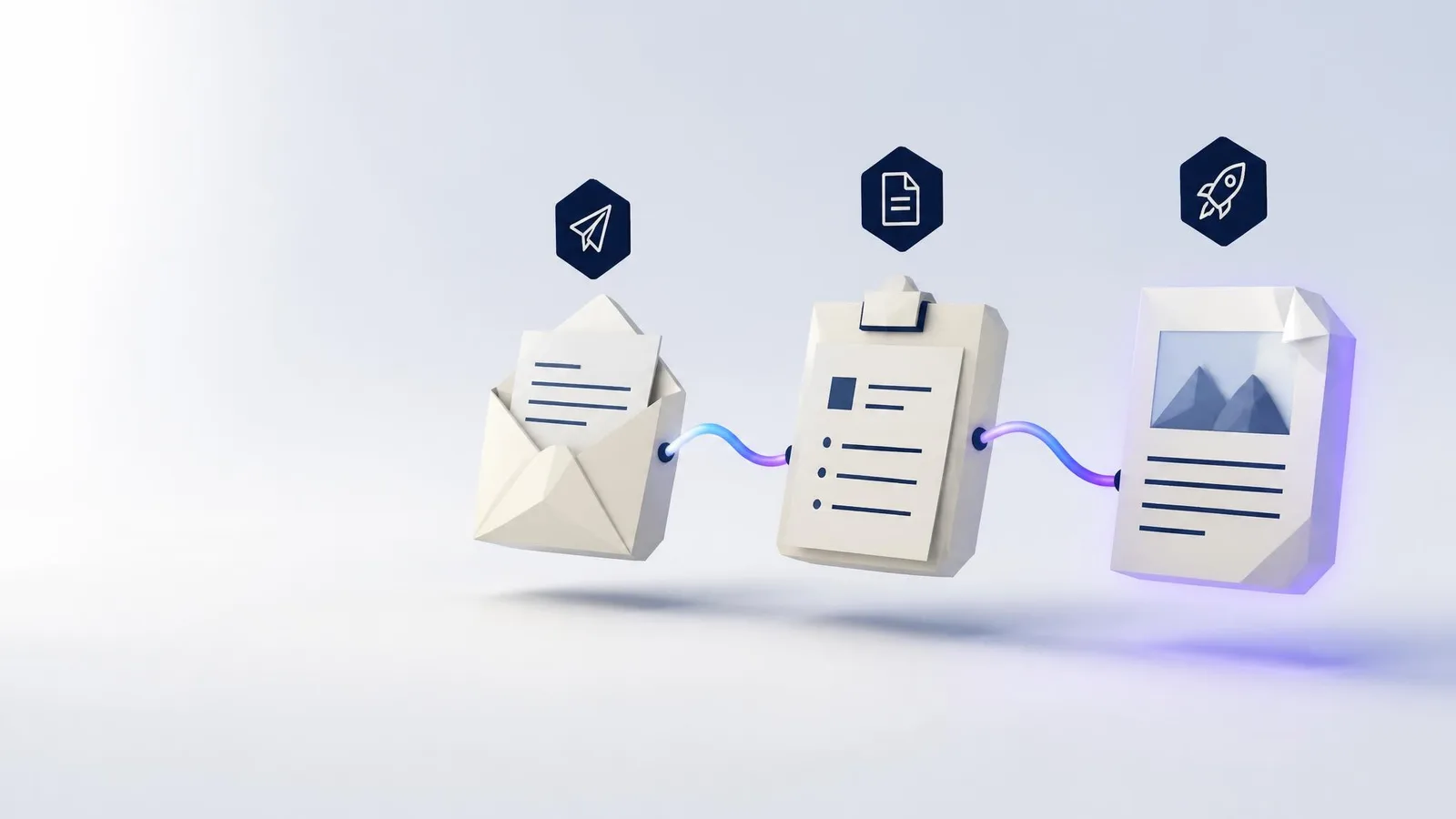
Here’s how to turn a prospect question into a blog article. Three steps, nothing fancy.
First, recognize the pattern in your email thread. You’ve now got 8 labels. Scroll your sent folder, spot one, and flag it.
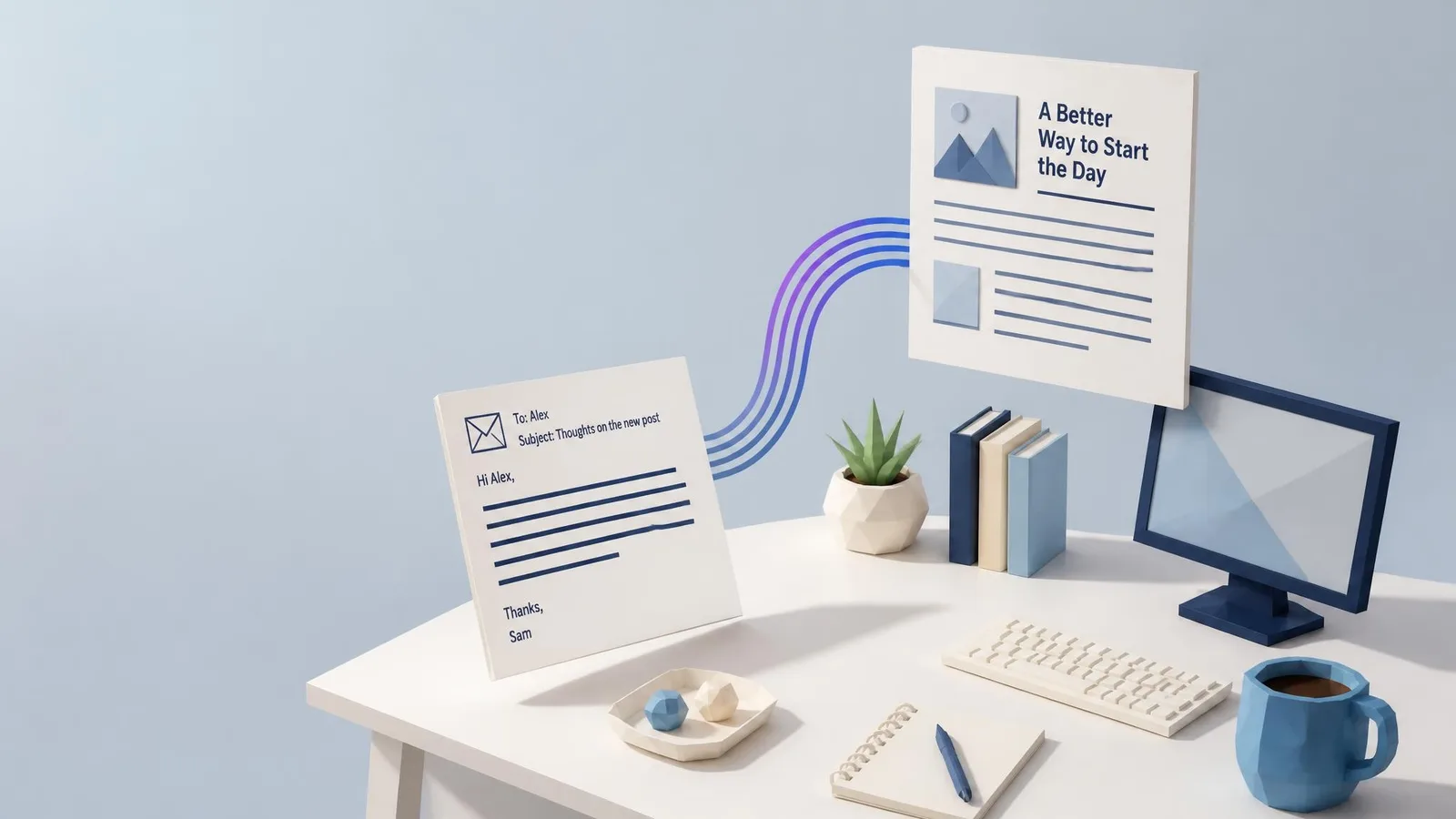
Second, use the email reply as your brief input. The prospect’s question is your working title. The key points from your reply are your section notes. You don’t need to rewrite anything. You need to reframe it: the email was addressed to 1 person, but the article needs a slightly wider lens and a structure that works for someone arriving cold from a search result.
Third, hand it to a production system that does the rest. The founder who tries to also be the writer, editor, and publisher is the founder who publishes once and stops. An email-to-content workflow for small businesses works because it treats your email reply as the starting brief, not the finished draft. You supply the question and the angle. The research, drafting, SEO structure, and quality checks get handled separately. That’s exactly what how cpywrk works is built for: you stay in the driver’s seat on the thinking, and the production runs without you.
Repurposing a sales email into a blog post sounds like a content hack. It’s closer to an operating system. You’re already doing the research. You’re already writing the answers. The only missing piece is a bridge between the inbox and the publish button.
Frequently Asked Questions
What do I do when I’m answering the same question over email every week?
That’s the repetition signal. Write the article. The threshold is lower than most founders think: 3 instances in the same month is enough to justify publishing. If you’ve typed a version of the same answer 3 times, you’ve already proven the demand.
How often does a question need to come up before it’s worth a blog post?
3 times is a reasonable threshold, but topic specificity matters too. A question you’ve answered 3 times for prospects in the same industry is worth more than one you’ve answered 10 times for wildly different contexts. The tighter the audience overlap, the stronger the article.
What types of emails make good blog content?
The 8 patterns above are the reliable ones. The emails least likely to translate are those that are genuinely one-off: highly personal situations, bespoke pricing conversations, or legal specifics. If you can imagine a stranger Googling the same question, it’s a candidate.
Can I just paste my sales email replies into a blog post?
The email is the brief, not the draft. Your reply has the right argument and the right language, but it’s addressed to 1 person. An article needs a slightly wider frame and a structure that works for readers arriving cold from search. Think of the email as raw material: the insight is there, but the packaging needs to change.
What if my email answer feels too niche?
Niche is usually an asset. If 5 prospects have asked the same specific question, there are likely hundreds of people searching for the same thing. Specific content ranks and converts better than general content because it matches the exact query someone typed, and it faces less competition in search results.
Conclusion
Content ideas for founders don’t require a new process. They require recognizing the one that’s already running in your sent folder every week. You’ve been doing the research. You’ve been writing the answers.
Open your inbox, find 1 of the 8 patterns, and treat that email thread as the starting point for your next article. Then Start free trial and turn it into something published.
cpywrk
Every article here was made by cpywrk itself: researched, drafted, and run through the same quality and GEO checks the product applies to customer content, then read and approved by a person before it publishes. The blog is the proof.
Related reading
When to Use AI for Content: 7 Jobs to Delegate, 3 to Keep
Discover which content tasks AI handles reliably and which three you must keep yourself, based on where AI is confidently wrong about real-world facts.
7 min read
8 Ways to Keep Your Brand Voice in AI Copywriting
AI drafts default to generic. Here are 8 interventions, from prompt setup to post-draft editing, that keep your brand voice in AI copywriting intact.
6 min read
6 Checks to Run Before Publishing Anything a Machine Drafted
Run these 6 checks before publishing AI content to catch hallucinations, brand voice drift, broken links, and the errors fluency alone won't reveal.
7 min read